Hakuen Studio Custom Parameters for RPG Maker MZ
A downloadable RPG Maker Plugin
Introduction
This plugin lets you create custom parameters that can work the same way the default parameters works. So, if you want to have more than 8 parameters, this is it! You can create as many as you want, including parameters that works like HP/MP.
Features
- Add new custom parameters to actors and enemies!
- Manipulate these parameters with note tags, plugin commands, or script calls!
- Add buffs, debuffs, multiplier traits, regeneration, and growth effects to these parameters!
- Create parameters that work like HP/MP/TP, with a maximum value and a current value!
How to Use
Parameter References
In general, you can reference a custom parameter using:
- ID → Starts at 0. The first parameter created in the Plugin Manager will be ID 0.
- ShortName → The short name configured in the parameter. It is case sensitive.
- FullName → The full name configured in the parameter. It is case sensitive. To be used most for menus or text.
When in doubt, use the ID or the shortName. They are the safest forms for note tags and script calls.
Note Tag: CParams for Classes, Weapons, Armors, and Enemies
To add new parameter changes for the weapons/armors/class/enemies, you can use the following note tag on the note fields:
(Enemy note field only works for enemy without classes, in case you are using Eli Enemy Classes)
<CParams:paramId/shortName:value, paramId/shortName:value>
You can either use the paramId or the shortName of the new parameters. The id will start at 0. This means that the new parameter id 0 will be the first one you have created.
Example:
<CParams: crm:23, 1:37> → Will add 23 to the crm parameter, and 37 for the new parameter id 1.
Optionally, you can also use the plugin parameter templates for that:
<CParams: TemplateName>
For both ways, if you don't set a specific parameter, it will be equal to 0.
Note Tags: CParamRate, CDebuffRate, CParamRegen
You can use the note tags below to add traits related to custom parameters. They can be used in the note fields of actors, classes, weapons, armors, enemies, and states.
- <CParamRate: paramId/shortName:value>
- <CDebuffRate: paramId/shortName:value>
- <CParamRegen: paramId/shortName:value>
If you want to add more than one parameter, separate each one with a comma ",".
Examples:
- <CParamRate: crm:150%, wis:1.25>
- <CDebuffRate: crm:50%>
- <CParamRegen: rep:10%>
Explanation:
- CParamRate → Multiplies the final value of the custom parameter. Use 150% for 1.5x, or 1.5 for the same effect.
- CDebuffRate → Multiplies the chance of receiving custom debuffs. Use 0% for immunity, 50% for half the chance, 200% for double the chance, etc.
- CParamRegen → Regenerates, on each automatic battler regeneration, a percentage of the maximum value of an HP/MP/TP type custom parameter. Use 10% to recover 10% of the maximum.
CParamRegen only makes sense for parameters configured as HP/MP/TP type, because it changes the current value based on the maximum value.
Note Tag for Items and Skills
You can use the following note tags on the item and skill note fields to add effects to the new parameters:
- <AddCBuff: paramId/shortName:turns >
- <RemoveCBuff: paramId/shortName >
- <AddCDebuff: paramId/shortName:turns >
- <RemoveCDebuff: paramId/shortName >
- <GrowC:paramId/shortName:value >
If you want to add more than one parameter, separate each one with a comma ",".
Examples:
- <AddCBuff: crm:3, wis:5>
- <AddCDebuff: rep:4>
- <RemoveCBuff: crm, wis>
- <RemoveCDebuff: rep>
- <GrowC: crm:2>
Explanation:
- AddCBuff → Adds or strengthens a custom buff. The value after the colon is the duration in turns.
- AddCDebuff → Adds or strengthens a custom debuff. The value after the colon is the duration in turns.
- RemoveCBuff → Removes an active custom buff.
- RemoveCDebuff → Removes an active custom debuff.
- GrowC → Permanently increases the target’s custom parameter value, similarly to the Grow effect for default parameters.
Custom buffs can reach up to level +2. Custom debuffs can reach up to level -2. Each level changes the parameter by 25%, following the RPG Maker default buff logic.
Plugin Parameters
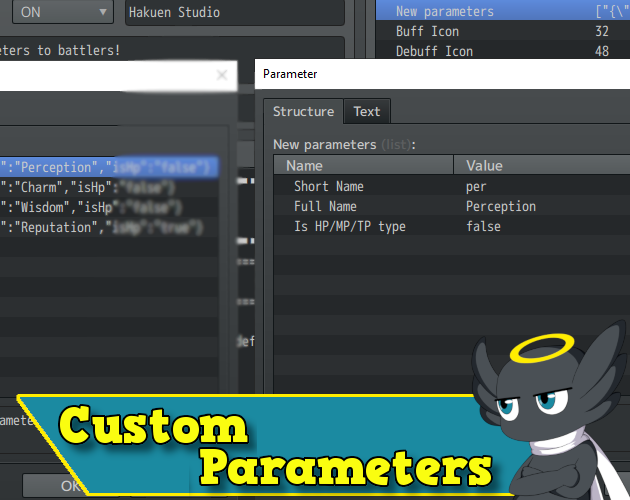
New Parameters
Here you can create as many custom parameters as you want. This will make these parameters exist in the game.
Each entry will have the following:
- ShortName → This will be the one that you will use to reference script calls and note tags. It cannot contain spaces. It is case sensitive. If your parameter is named “wis”, you can reference it as “this.wis”, “$gameActors.actor(ID).wis”, etc. A variant with an underline prefix will be created automatically, such as “_wis”. It represents the current value when the parameter is an HP/MP/TP type. However, I recommend using plugin commands or the plugin’s own script calls to change values.
- FullName → This will be the full name of the parameters. That can appear on battle log etc.
- HP/MP/TP type → When enabled, the shortName represents the current value, while “max” + shortName represents the maximum value. Example: “rep” for the current value and “maxrep” for the maximum value.
Avoid using shortNames that are the same as native RPG Maker properties or parameters, such as hp, mp, tp, atk, def, mat, mdf, agi, or luk. This can cause conflicts with existing properties.
Buff / Debuff Icon
You can choose the buff and Debuff icon range for these parameters.
They work exactly like the default ones. They will get an icon in the icon sheet and will follow a range.
With the exception that the range must follow how many custom parameters you have added.
The default works like that:
- You have 8 default parameters: hp, mp, atk... etc.
- The buff icons for these parameters go from the icon index 32 to 48.
- This means the index 32 will be the Hp Buff level 1; Index 33 will be Hp buff level 2. And so on.
- The same for Debuff, which takes the icon index 48 to 62.
- 48 Hp Debuff level 1
- 49 Hp Debuff level 2.
So you must follow the same logic for the buff and debuff icons for these new parameters. If you have 4 custom parameters, each buff/debuff level will use 4 icons in sequence.
Templates
Here you will be able to create a custom parameter configuration, that later on, can be added into a note tag by using the template name. More specifically, only on the CParams note tag.
Each entry, has the following:
- Name → The template name to set on the class note field.
- List → The configuration of the custom parameters that will be attached to this template.
- Id → The parameter ID or short name.
- Value → The value of this parameter.
Plugin Commands
You can use the plugin commands to manipulate the custom parameters.
Add/Remove/Set (Change Parameter)
This is similar to the Change Parameter event command. You will be able to remove, add, or set a value for the parameters.
- Battler type → What kind of battler the command will be for. Actors, Enemy, Party, or Troop.
- Battler Id/Index → You can use multiple operators here to decide which battlers will be targeted. If the type is set as Actor or Enemy, these numbers will be IDs. If the type is set as Party or Troop, these numbers will be indexes.
- Custom Param Id → The custom parameter ID or short name.
- Operation Type → You have two options here:
- Add/Remove → Negative numbers will subtract and positive numbers will add to the parameter current value.
- Set → It will assign this value to the parameter.
- Value → The value to assign to the parameter. Can use \v[id] and formulas.
If a custom parameter is HP Type, this command will change their maximum values. If you don’t want that, use the command below.
Add/Remove/Set (change HP/MP/TP)
It is almost the same as above. With the exception that this command only works for custom parameters that are HP types. It is similar to the event command that changes HP/MP/TP.
Script Calls
You can use them with actors or enemies:
- $gameActors.actor(ID).[script call] → For actors.
- $gameParty.members()[index].[script call] → For Party Members.
- $gameTroop.members()[index].[script call] → For Enemies.
Main script calls:
- .cparamBase(paramId)
- .cparamPlus(paramId)
- .cparamBasePlus(paramId)
- .cparamRate(paramId)
- .cparamBuffRate(paramId)
- .cdebuffRate(paramId)
- .cparamRegenRate(paramId)
- .cparam(paramId)
- .addCParam(paramId, value)
- .changeCustomParam(paramId/shortName, value)
- .setCustomParam(paramId/shortName, value)
- .changeCustomHpParam(paramId/shortName, value)
- .setCustomHpParam(paramId/shortName, value)
- .recoverCustomHpLikeParameter(paramId/shortName)
Example:
You can also reference them using the method below, with the ID:
- $gameParty.members()[0].cparam(0) → Will return the value of the first Custom Parameter.
You can also reference them using the object name directly, which is the short name:
- $gameParty.members()[0].crm → Will return the crm(charm) value
For those parameters that work like HP/MP/TP, you will reference the current value of them with the script calls above. But to get the max value, you can use the prefix "max" before the shortname:
- $gameParty.members()[0].maxrep
To change the current parameter value, like changing the hp and not the mhp, you can use the following:
- $gameParty.members()[0].changeCustomHpParam(paramId/shortName, value)
To set a value, you can use the below:
- $gameParty.members()[0].setCustomHpParam(paramId/shortName, value)
You can do the same for the custom parameters that are not hp/mp/tp type:
- $gameParty.members()[0].setCustomParam(paramId/shortName, value)
This one, instead of adding or removing a value, it will set a value for the custom parameter.
- $gameParty.members()[0].addCParam(paramId/shortName, value)
Compatibility
Works with my plugins EliMZ_EnemyClass, EliMZ_ClassCurves, EliMZ_DynamicParameters.
How to use | Terms of use | Sample Project

Download
Click download now to get access to the following files:
Development log
- Custom Parameters 2.1.1 - Bug fixes and compatibilityJun 02, 2026
- Custom Parameters 2.1.0 - New features and bug fixes!May 24, 2026
- Version 2.0.3 - New features, bug fixes, compatibilityJul 28, 2024
- Version 5.0.2 - Bug fix!Jul 05, 2024
- Version 5.0.0 - Updated terms of use.Feb 09, 2022
- 08/25/2021 - New features!Aug 25, 2021
- 05/17/2021 - Help file changesMay 17, 2021
- 05/17/2021 - Minor changesMay 17, 2021


